

Rhode Island White Collar Crime Lawyer
If you have been contacted by federal agents, received a target letter, or learned that you are under investigation for a financial crime in Rhode Island, the time to engage defense counsel is now - not after charges are filed. White collar prosecutions are built quietly over months or years before the defendant ever knows. By the time charges arrive, the prosecution has already assembled emails, financial records, witness statements, and forensic accounting. A Rhode Island white collar crime lawyer at Bank & Munns defends clients at every stage - from pre-indictment investigation through trial and sentencing.
Free 24/7 consultation: 401-573-2265.
What Is a White Collar Crime in Rhode Island?
White collar crime is a broad category covering non-violent offenses motivated by financial gain, typically committed in a business, professional, or governmental context. Unlike street crimes, white collar charges turn on documents, transactions, fiduciary duties, and intent - evidence that can be devastating in volume but is rarely as conclusive as the prosecution makes it appear.
White collar crimes in Rhode Island can be charged at three different levels:
- State charges - prosecuted in Rhode Island Superior Court under Title 11 of the Rhode Island General Laws
- Federal charges - prosecuted in the U.S. District Court for the District of Rhode Island under Title 18 of the United States Code
- Parallel state and federal - some cases involve both jurisdictions simultaneously
Federal involvement triggers when the case crosses state lines, involves federal agencies, uses interstate communication systems (mail, wire, internet), or exceeds dollar thresholds that bring U.S. Attorney attention. Federal prosecutions follow different procedural rules, sentencing guidelines, and standards than state cases - a defense lawyer experienced only in state criminal defense is at a serious disadvantage in federal court.
Common White Collar Charges in Rhode Island
Bank & Munns defends the full range of white collar charges, including:
Embezzlement
Rhode Island embezzlement is governed by R.I. Gen. Laws § 11-41-3. It applies when someone lawfully entrusted with money or property converts that property to their own use without authorization. Embezzlement of $1,500 or more is a felony in Rhode Island, with exposure up to 20 years in state prison and significant restitution obligations. Common defendants include bookkeepers, accountants, store managers, financial advisors, and anyone in a fiduciary capacity.
Forgery and Counterfeiting
Forgery charges in Rhode Island are governed by R.I. Gen. Laws Chapter 11-17. The statute covers signing, altering, or passing documents you do not have authority to create or modify - including check forgery, uttering forged documents, credit card forgery, and altering legal instruments. Penalties scale with the type of document and the amount involved.
Identity Theft
Rhode Island identity theft is prosecuted under R.I. Gen. Laws § 11-49.1. The statute criminalizes using another person’s name, Social Security number, credit information, or personal data without authorization. Identity theft cases can be charged at the state level or federally under 18 U.S.C. § 1028 - federal charges typically apply when the case involves interstate commerce or federal benefits programs.
Credit Card Fraud
Credit card fraud in Rhode Island falls under R.I. Gen. Laws § 11-49 and can be charged as a misdemeanor or felony depending on the dollar amount and the specific conduct (using a stolen card, skimming, manufacturing fraudulent cards, or unauthorized use of account information).
Computer Crimes
Rhode Island computer crimes are prosecuted under R.I. Gen. Laws Chapter 11-52. The chapter criminalizes unauthorized access, computer trespass, computer-related fraud, and related electronic offenses. Federal computer crime charges may also apply under the Computer Fraud and Abuse Act (18 U.S.C. § 1030).
Insurance Fraud
Insurance fraud in Rhode Island includes filing false claims, staged accidents, inflated medical billing, arson-for-insurance, and false statements on insurance applications. The Rhode Island Department of Business Regulation’s Insurance Fraud Unit refers cases to the Attorney General’s office for prosecution. Penalties depend on the amount of the loss and whether the offense is charged as a felony or misdemeanor.
Securities Fraud
Securities fraud cases involve material misrepresentations or omissions in connection with the purchase or sale of securities. Rhode Island state cases are prosecuted under the Rhode Island Uniform Securities Act, and federal cases are prosecuted under the Securities Act of 1933 and the Securities Exchange Act of 1934. SEC enforcement actions and parallel criminal prosecutions often run concurrently.
Wire Fraud and Mail Fraud
Wire fraud (18 U.S.C. § 1343) and mail fraud (18 U.S.C. § 1341) are federal charges that apply to virtually any fraud scheme that uses interstate phone, internet, or mail communications. Federal prosecutors use these statutes broadly because the elements are easy to prove once a fraud is established. Each act of wire or mail communication can be charged as a separate count.
Money Laundering
Money laundering charges (18 U.S.C. § 1956 and § 1957) attach when proceeds of an underlying offense are processed through financial transactions designed to conceal their origin. Money laundering frequently appears as a companion charge to fraud, drug trafficking, or other revenue-generating crimes.
Tax Evasion and Tax Fraud
Tax fraud cases are prosecuted federally under Title 26 of the U.S. Code by the IRS Criminal Investigation Division and the U.S. Attorney’s Office. Common charges include tax evasion (26 U.S.C. § 7201), filing false returns (26 U.S.C. § 7206), and failure to file (26 U.S.C. § 7203).
Bribery and Public Corruption
State bribery charges fall under R.I. Gen. Laws Chapter 11-7. Federal bribery cases involve public officials or programs receiving federal funds, prosecuted under 18 U.S.C. § 201 or related statutes. Public corruption cases attract media attention and prosecutorial intensity that few other charges match.
Penalties for White Collar Crimes in Rhode Island
White collar penalties scale dramatically with the dollar amount, the number of victims, the duration of the conduct, and whether the case is charged at the state or federal level. Common consequences include:
- Prison sentences - state felony exposure up to 20 years for embezzlement; federal sentences can exceed 20 years for major fraud cases under U.S. Sentencing Guidelines
- Restitution - mandatory in most white collar cases; full repayment to victims can dwarf the criminal fine
- Fines - state fines vary by offense; federal fines can reach $250,000 per count or twice the gross gain or loss
- Forfeiture - the government can seize assets traceable to the offense, including bank accounts, real estate, and vehicles
- Professional license loss - attorneys, accountants, financial advisors, healthcare providers, and others lose their licenses on conviction
- Permanent record - white collar felony convictions are not eligible for expungement under R.I. Gen. Laws § 12-1.3-2
- Immigration consequences - most white collar felonies are deportable offenses for non-citizens
- Reputational damage - white collar charges generate media coverage that can destroy careers even when charges are reduced or dismissed
Defense Strategies for White Collar Cases
White collar defense is fundamentally different from violent crime defense. The cases are document-heavy, witness-heavy, and often span years of conduct. Common defense angles include:
- Lack of intent - white collar charges typically require specific intent to defraud or knowingly convert. Mistake, negligence, or good-faith reliance on others can defeat the intent element.
- Lack of knowledge - in cases involving complex organizations, the defendant may not have known about the underlying conduct.
- Authority defense - in embezzlement and fraud cases, proving the defendant had authority to take the action removes the criminal element.
- Statute of limitations - many white collar offenses have strict limitation periods; charges filed outside that window must be dismissed.
- Fourth Amendment challenges - search warrants for business records, computer drives, and email accounts can be challenged when probable cause is weak or the warrant is overly broad.
- Privilege challenges - attorney-client privilege, work product doctrine, and Fifth Amendment protections can shield key materials from prosecution.
- Cooperation and proffer - in some cases, early cooperation with prosecutors can result in significantly reduced exposure or non-prosecution agreements.
- Pretrial diversion and deferred prosecution - available in certain cases, particularly for first-time offenders willing to make full restitution.
Why Early Engagement Matters in White Collar Cases
The most important hour in a white collar case is often the first hour after the defendant learns of the investigation. Decisions made before any lawyer is involved can permanently foreclose defense options:
- Voluntary statements to investigators become evidence at trial
- Document destruction can trigger separate obstruction charges
- Failure to preserve attorney-client privilege can waive it permanently
- Talking to co-workers about the investigation can create witness coordination issues
- Communication with co-defendants can be characterized as conspiracy
If you have been contacted by an FBI agent, an IRS Criminal Investigation Division special agent, an SEC enforcement attorney, the Rhode Island Attorney General’s office, or any other investigator, do not give a statement. Do not consent to searches. Do not destroy or alter records. Call defense counsel immediately.
Charged or Under Investigation? Call Now.
White collar charges and investigations carry consequences that can outlast any criminal sentence - lost careers, lost professional licenses, lost reputation, lost assets through forfeiture and restitution. The earlier defense counsel is engaged, the more options remain open.
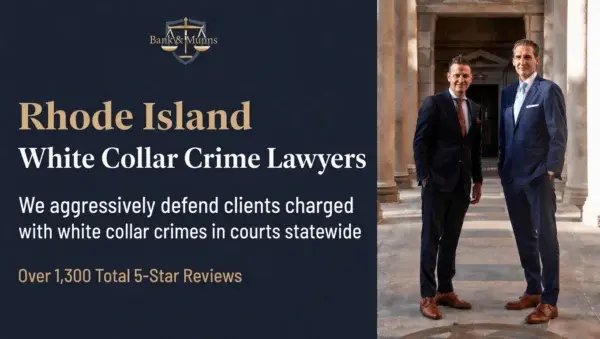
Call Bank & Munns at 401-573-2265 - available 24 hours a day, 7 days a week. Free consultation. Attorneys Chad F Bank and Rory Munns defend white collar cases at the state and federal level across Rhode Island.
This page provides general information only and does not constitute legal advice. Every white collar case depends on facts not knowable from public materials. If you are under investigation or have been charged, talk to a lawyer about your specific situation immediately.